Revive the Pixelated Past: A Guide to the Retro 80s–90s Tech Illustration Pack
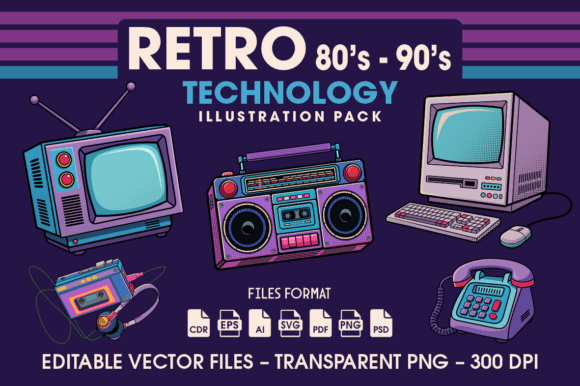
There is a specific, warm feeling associated with the technology of the late 20th century—the satisfying clunk of a keyboard, the mechanical whir of a cassette tape, or the static hum of a cathode-ray television. For designers and creators working within the realms of brand identity and editorial design, capturing this analog nostalgia requires more than just a filter; it demands authentic design assets. The Retro 80s–90s Tech Illustration Pack offers exactly that. It is a curated collection of five vector illustrations depicting the iconic devices that defined our digital childhood: a vintage TV, a cassette boombox, a portable Walkman, a retro landline, and a classic personal computer. These aren't just clip art images; they are detailed vectors designed to bring a tangible sense of history to modern projects.
Understanding the Visual Language
The strength of this collection lies in its ability to bridge the gap between vintage charm and modern typography standards. Unlike rasterized images that pixelate when scaled, these vector files maintain their crisp lines whether they are used on a small business card or a massive outdoor banner. The style leans into the distinct aesthetic of the era—chunky forms, distinct shading, and the physical weight of the hardware.
When you integrate these assets into your workflow, you are not just adding a picture; you are establishing a visual hierarchy that speaks to a specific audience. For entrepreneurs in the tech sector or gaming industry, these illustrations serve as a powerful creative font alternative for visual storytelling. They provide a counterpoint to the sleek, glass-morphism designs of today, offering a sense of durability and reliability that resonates with consumers aged 20 to 50. The personality of the pack is grounded and tactile, making it an excellent companion to both serif font bodies for a classic feel or bold sans serif font headers for a retro-futuristic contrast.
Practical Applications for Creators and Businesses
The versatility of the Retro 80s–90s Tech Illustration Pack makes it a powerhouse for various mediums. For those involved in packaging design or creating digital end products, the utility of these files is extensive. Because the pack includes AI, EPS, SVG, PDF, PNG, JPG, CDR, and PSD formats, you have complete control over color manipulation and composition.
Here are practical ways to leverage these assets:
- Brand Identity & Logo Design: While you shouldn't use a stock illustration as a direct logo, these vectors are perfect for creating custom mascots or secondary brand marks. A podcast about vintage computing, for instance, could use the old PC illustration as a favicon or a watermark on social media graphics.
- Merchandising and POD: The high-resolution 300 DPI PNGs with transparent backgrounds are print-ready. For T-shirt designers or sticker creators, the ability to isolate the Walkman or the Boombox allows for quick composition. By combining these illustrations with a handwritten font or a script font, you can create merchandise that feels personal and artisanal.
- Editorial and Web Design: Bloggers and publishers can use these images to break up long blocks of text. A vintage TV works perfectly as a featured image for an article about the history of media, while the retro telephone can illustrate a post about communication trends. In web design, these vectors can be used as custom bullet points or section dividers to reinforce a cohesive theme.
Strategic Design and Font Pairing
Integrating retro illustration with modern typography requires a strategic approach to ensure readability and professionalism. The goal is to avoid looking dated in a sloppy way, instead aiming for a curated, nostalgic aesthetic.
When selecting a typeface to accompany this pack, consider the "voice" of the illustration. The heavy, boxy nature of 80s tech pairs exceptionally well with geometric sans serif font families. Fonts like Futura or Eurostile echo the digital optimism of the era. Conversely, pairing the illustrations with a sturdy serif font can create a "textbook" or "vintage manual" vibe, which is excellent for classroom materials or educational content.
Avoid using overly decorative script font styles that might clash with the hard edges of the technology. Instead, if you want a softer touch, a legible handwritten font can add a human element to the mechanical subjects, suggesting a journal entry or a personal memory. Always test your font pairing at the intended scale. Ensure that the detail in the illustrations does not compete with the x-height of your text, maintaining a clear visual hierarchy.
Licensing and Usage Guidelines
Understanding the permitted usage of commercial font and asset packs is vital for any professional. The Retro 80s–90s Tech Illustration Pack is designed to be a flexible tool for both personal and commercial projects. You are free to incorporate these designs into printed products, merchandise, and unique digital designs.
However, the value of premium font and illustration packs relies on ethical usage. You cannot resell, share, or redistribute the raw files as-is. This means you cannot simply upload the vector files to another stock site or sell the unmodified illustration on a mug without adding your own creative input. The intent is for these to be components of a larger design, not the entirety of the product itself. By respecting these boundaries, you ensure the sustainability of high-quality design assets in the marketplace.
Final Thoughts on Execution
The Retro 80s–90s Tech Illustration Pack is more than just a set of images; it is a toolkit for evoking emotion. In a digital landscape often dominated by sterile minimalism, these illustrations offer a way to connect with an audience that remembers the tactile nature of early technology. Whether you are a small business owner designing a retro-themed cafe menu, a content creator looking to spice up social media graphics, or a designer building a brand identity for a synth-wave artist, this collection provides the foundational assets you need. By combining these detailed vectors with thoughtful typography and a clear design strategy, you can transform a simple project into a memorable experience.